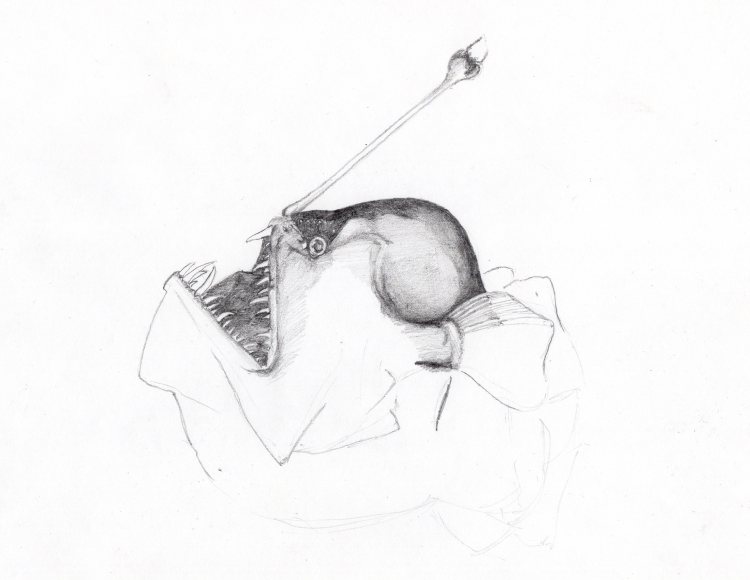
I am awestruck by the creatures of the deep ocean. The shapes and forms and adaptations that occur are beyond imagining. And as I think about it, the deep ocean is really a designer’s paradise. The conditions there are such that evolution can proceed free from many of the constraints imposed upon creatures here on the surface like the downward force of gravity, seasonal changes in the atmosphere and the availability of light.
Consider the downward force of gravity. Here on the surface, gravity has a significant influence on the size and shape of living things. Elephants, for example, are able to be so large because their legs are essentially cylindrical pillars supporting the girth of their bodies like Greek columns. Elephants have the benefit of an internal skeleton. Invertebrates aren’t as fortunate and so are limited in the size they can reach. If you try to proportionally grow an insect to the size of that elephant it wouldn’t be able to stand. An insect’s legs are just not in a position or of a scalable dimension that would allow its body to be supported. In the deep ocean, however, the force of gravity is non-existent compared to the water pressure and as a result, not only is the limit on size lifted, but the imposed rule that the organism must be shaped so as to support its body weight is also lifted. And nature fully exploits this as evidenced by the remarkable diversity of body shapes that occur among invertebrates of the deep ocean and of the sizes of those invertebrates that conjure tales of sea monsters.
Seasonal changes and the availability of light impact the energy requirements of an organism. Here on the surface, animals have to respond to seasonal changes as they often determine the available of food and/or shelter. Migration, hibernation, estivation are all strategies employed by animals to cope with these changes. The evolution of internal temperature control as seen in mammals and birds and some fish is another strategy. But there is a cost to these strategies; an energy cost. Warm blooded animals require a lot of energy to maintain those internal heaters and cold blooded animals are simply restricted to living in specific environments. Now the deep ocean isn’t an environment of great abundance, it is quite harsh and desolate, but its conditions are relatively static. This perpetually dark, static environment means that organisms can make more efficient use of energy by neglecting to form certain structures, like eyes, that may be unnecessary or by forming structures that would lower their overall energy requirement, like the modified tentacles on a dumbo octopus that allow it to move with minimal expense of energy.
It is true that the deep ocean is largely devoid of resources aside from the oases of volcanic vents and the drive toward energy efficiency is vital to the survival of any organism of the ocean deep. But the freedom from the limitations of the surface means that these creatures are able to go to the extremes of body design to maximize their chances of survival. And the results are absolutely amazing.
 My Box of Unfinished Projects